The World’s Biggest Brand Is Having Its Toughest Tournament

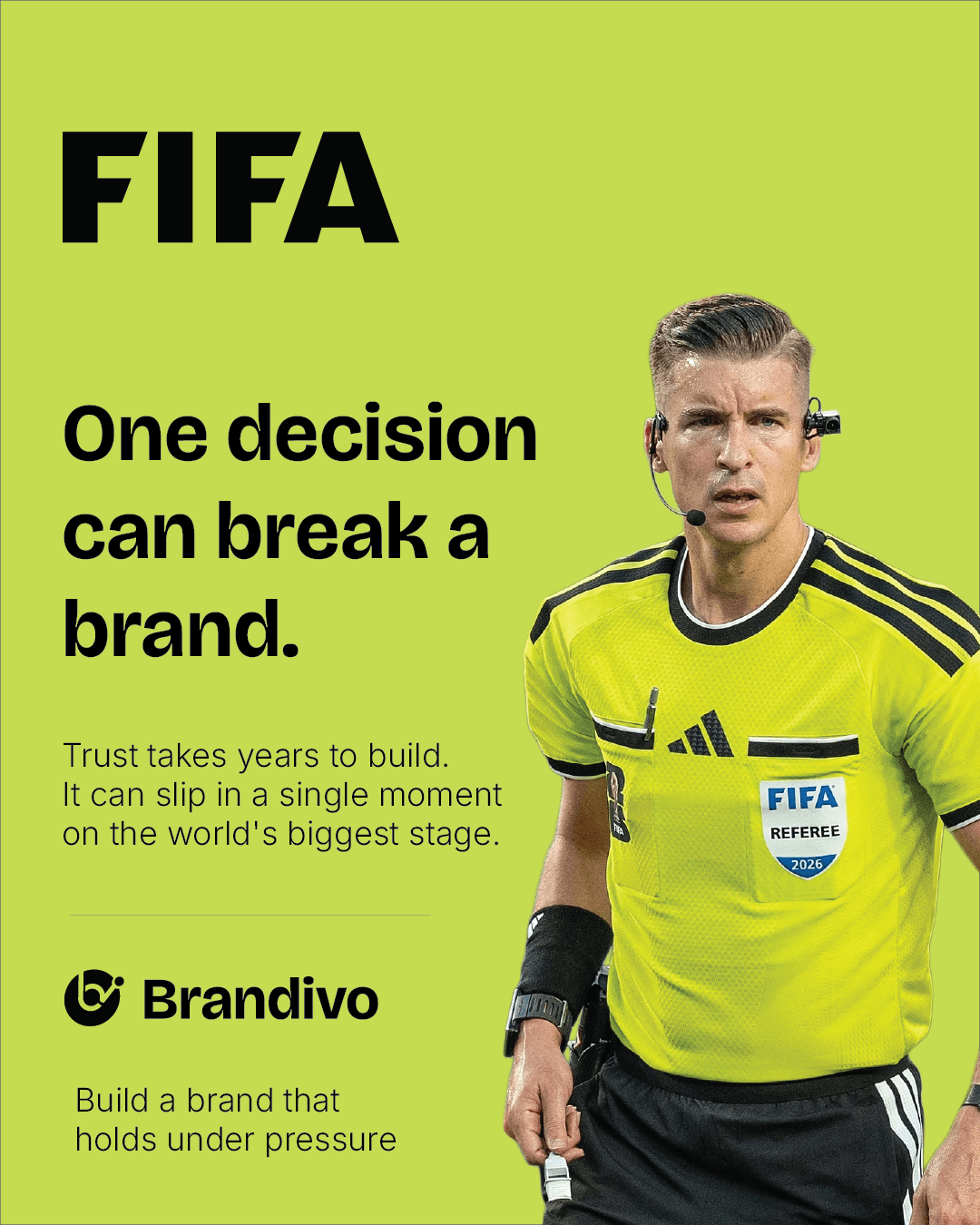
What the 2026 World Cup is teaching us about institutional trust — and why perception, not just performance, is what actually breaks a brand
FIFA doesn’t need an introduction. Four letters recognized in more countries than almost any other institutional mark on earth, attached to a tournament that pulls in more collective attention than anything else in sport. The 2026 World Cup, spread across the United States, Canada, and Mexico, is the biggest version of that tournament yet — more teams, more matches, more eyes.
It’s also turning into one of the harder stretches for FIFA’s brand in recent memory. Not because of any single scandal, but because of how many separate threads of doubt have opened up at once, all pulling at the same core question: can this institution be trusted to run the game fairly?
The pattern, not the incident
On its own, a single controversial refereeing call is just sport. Fans have argued over offside lines and phantom fouls for a century, and one bad decision rarely does lasting damage to the body that governs the game. What’s different about this tournament is the accumulation.
Egypt’s Round of 16 exit to Argentina became a flashpoint after a disallowed goal, a waved-away penalty appeal, and a stoppage-time winner all landed the same way — in Argentina’s favor, in a match built around Lionel Messi’s continued run in the tournament. Egypt’s federation filed an official complaint. The country’s manager publicly said his team had been treated unfairly. Commentators and public figures who aren’t normally part of football conversations weighed in, some in blunt terms about the tournament’s credibility.
That match didn’t happen in isolation. It landed in the middle of a summer already carrying other officiating flashpoints — a red card overturned after political pressure became public, a match official cleared of an on-air gesture that briefly raised concern, and a running conversation among managers and pundits about inconsistent VAR application across different games and different officiating crews. Individually, each of these is defensible as a judgment call or a cleared misunderstanding. Together, they read as a pattern to a lot of people watching — and patterns are what erode trust, even when every individual data point has an innocent explanation.
Why this hits FIFA differently than it hits a referee
A referee’s brand is personal credibility. FIFA’s brand is something bigger and more fragile: it’s the promise that the system is fair, regardless of which official is on the pitch or which team is favored. That promise is the entire premise VAR was introduced to protect — a technological backstop meant to remove doubt, not add to it.
When decisions that VAR reviews and confirms still leave fans convinced something was off, the technology stops functioning as proof of fairness and starts functioning as evidence of the opposite — a process elaborate enough to look rigorous while still producing outcomes people don’t trust. That’s a much harder problem than any one referee having a rough night, because it’s not about a person anymore. It’s about whether the institution’s core mechanism for earning trust is actually working.
FIFA is also carrying reputational weight from outside the officiating conversation entirely this summer — criticism over ticket pricing, transit access at host venues, environmental impact projections for an expanded 48-team format, and travel and visa issues that prevented some fans, and at least one scheduled referee, from attending at all. None of these are new categories of criticism for a global sporting body. But they’re landing in the same news cycle as the officiating disputes, and audiences don’t file complaints into separate folders. They just experience “FIFA” as an institution having a difficult run of headlines.
The lesson underneath the noise
Strip away the football specifics and there’s a pattern that applies to any brand of any size: trust doesn’t erode from one bad moment. It erodes from an accumulation of moments that all seem to point the same direction, especially when the brand’s core promise is neutrality, fairness, or reliability.
A financial platform doesn’t lose customer trust because one transaction glitched. It loses trust when three unrelated glitches in one quarter start to look like a pattern of not caring enough about reliability. A hiring platform doesn’t lose credibility because one algorithm made a defensible call — it loses credibility when several defensible calls in a row all seem to break the same direction. The individual incidents are almost never the real story. The story is what people conclude about the system once they’ve seen enough of them.
This is also why transparency and consistency matter more than perfection. Institutions that explain their reasoning clearly, apply their own standards evenly, and don’t appear to bend under outside pressure get more benefit of the doubt when a single decision goes wrong. Institutions that seem to shift their standards case by case — even with good explanations each time — train their audience to stop trusting the standard itself.
Building a brand that can survive its hardest stretch
FIFA will very likely come out the other side of this tournament fine — the World Cup’s cultural gravity is bigger than any single controversy. But smaller brands, and especially early-stage ones, don’t have that kind of runway. A startup or a founder’s personal brand can’t absorb a summer’s worth of “just one more questionable decision” the way a hundred-year-old global institution can.
That’s exactly why the identity work has to happen before the pressure does — a clear, consistent voice; standards you actually apply the same way every time; and messaging that doesn’t have to be walked back the first time something doesn’t go your way. That’s what we build at Brandivo: complete brand identities — name, domain, visual system, voice, and guidelines — designed to hold together under scrutiny, not just look good in the pitch deck.
Because the brands that survive their hardest stretch aren’t the ones that never get questioned. They’re the ones consistent enough that being questioned doesn’t automatically mean being believed to be guilty.
Brandivo helps founders and teams build brand identities that hold up under real-world pressure — not just ones that look good on day one.