The GAA–Allianz Sponsorship Controversy: Why Every Brand Needs an Exit Philosophy

The Gaelic Athletic Association has decided to continue one of the longest-running sponsorship relationships in Irish sport. Allianz has supported the GAA’s national football and hurling leagues for more than 30 years. The existing league agreement reportedly continues until 2030.
On August 1, the GAA confirmed that its Management Committee and Central Council had reconsidered the relationship and agreed to maintain it. Current reporting describes the Central Council’s support as overwhelming. The decision follows more than a year of internal and public pressure. Players, county boards and pro-Palestinian campaigners have called on the association to drop Allianz because of financial activities associated with its global parent group.
The result is an important branding case study. A sponsorship may be commercially successful, legally valid and operationally valuable—while still becoming a persistent reputational dispute.
Why the sponsorship became controversial
A July 2025 report from the United Nations Special Rapporteur on the occupied Palestinian territory examined corporate relationships connected to Israel’s occupation and war in Gaza. The report identified PIMCO, an asset-management business owned by Allianz Group, among investors purchasing Israeli government bonds. It listed approximately US$960 million associated with PIMCO during the examined period.
Campaigners argued that this connection made Allianz an inappropriate sponsor for a community sporting organization. A petition carrying nearly 800 signatures from current and former players was submitted, several county boards supported motions calling for the relationship to end, and protests appeared at GAA events. The controversy also interrupted the organization’s annual congress in February 2026.
The GAA referred the matter to its Ethics and Integrity Commission, which recommended that the association retain the sponsorship.
The GAA’s position
The GAA’s reasoning has included several elements. Its direct commercial relationship is with Allianz Ireland rather than PIMCO. GAA President Jarlath Burns has argued that the Irish operation is not directly involved in the war and should not automatically be treated as responsible for every activity of the wider corporate group.
The organization has also pointed to practical consequences. Allianz is not merely a visible sponsor. It reportedly provides insurance or underwriting connected to GAA clubs and grounds. Ending the relationship could therefore affect operations as well as sponsorship income. The Ethics and Integrity Commission reportedly warned of possible contractual and legal consequences and questioned whether an alternative insurer could be found without similar international financial connections.
These are legitimate governance considerations. They do not eliminate the branding issue.
One logo, many legal entities
Large corporations are legally complex. They operate through:
- Parent companies
- Regional businesses
- Subsidiaries
- Investment arms
- Joint ventures
- Licensed operations
This separation can determine liability, contracts and regulation. Consumers rarely experience the structure that way. They see one company name.
They see one logo. They hear one global promise.
Allianz itself promotes the continuity of its GAA involvement as a relationship lasting more than three decades. The global name creates credibility and scale. That produces a difficult contradiction. A company benefits when the reputation of the global brand strengthens the local business.
When controversy develops elsewhere in the group, the local business may argue that the entities must be considered separately. Both positions may be legally coherent. They are not always emotionally persuasive.
Brands cannot assume that audiences will adopt corporate organizational charts as their model of moral responsibility.
Sponsorship is an exchange of reputation
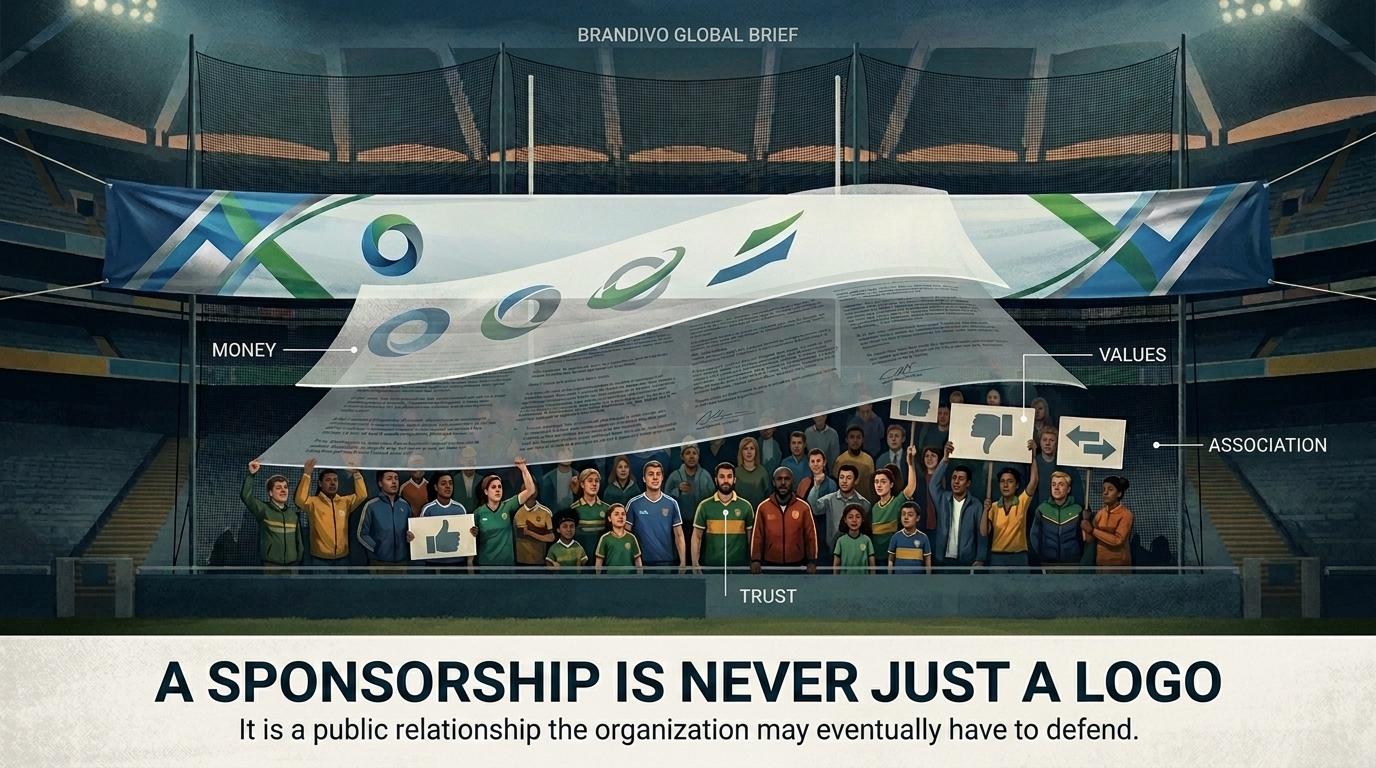
Sponsorship is commonly described as a commercial transaction. A sponsor provides money, products or services. The rights holder provides visibility, access and association but association is the essential word, The sponsor does not buy only signage.
It gains proximity to:
- The institution’s history
- Its supporters
- Its cultural importance
- Community trust
- Athletes and role models
- Shared rituals
The institution receives financial support but also accepts proximity to the sponsor’s reputation. When the sponsor’s name becomes controversial, the meaning of every logo placement can change. A sign that once communicated stability may begin attracting protest.
A title sponsorship that once created recognition may repeatedly revive questions about ethics. Visibility remains high. Its value becomes contested.
The myth of neutral continuation
Organizations sometimes behave as though retaining an existing partnership is a neutral choice, while termination would represent an active political statement. That is not always how audiences see it.
Once credible concerns have been raised and reviewed, continuation becomes a decision. The organization is saying that the relationship remains acceptable under its standards. That does not mean retention equals agreement with every activity attributed to the sponsor. It does mean the institution has decided the objections are insufficient to outweigh the commercial, legal and operational case for remaining.
The decision therefore requires explanation. Silence allows opponents to define what the continuation means.
The limits of morality clauses
Many sponsorship contracts contain morality or reputational clauses. These provisions may allow one party to terminate if the other engages in conduct that causes public scandal or reputational harm. But such clauses rarely resolve every issue. They may be narrow, they may require proof of misconduct, They may apply only to the contracting entity.
They may create expensive litigation, they may not cover controversial investments that are legal, they may fail to reflect the concerns of members and supporters. A legal exit mechanism is necessary. It is not a complete ethical framework.
Every brand needs an exit philosophy
Before entering a major sponsorship, organizations should decide how potential controversies will be evaluated. A practical framework should address seven areas.
1. Scope of association
Does scrutiny apply only to the contracting company, or also to its parent, subsidiaries and major owners?
2. Evidence threshold
Will the organization act only after a legal judgment, or can credible reporting, regulatory findings or independent investigations trigger review?
3. Stakeholder voice
Will employees, athletes, customers, members or community representatives participate?
4. Severity
Which issues justify concern, formal remediation or termination?
5. Financial tolerance
How much commercial cost is the organization genuinely prepared to accept to protect its values?
Values that disappear when they become expensive are positioning statements, not operating principles.
6. Remediation
Can the sponsor explain, divest, change policies, provide transparency or take another step that makes continuation acceptable?
7. Communication
Who announces the decision, which evidence is disclosed and how will disagreement be acknowledged?
The sponsor needs the same framework
Sponsors should also prepare for controversies involving rights holders. A company may discover that a league, event or cultural institution behaves in ways inconsistent with its values. It needs to determine:
- When to request change
- When to suspend activation
- When to withdraw
- Whether it will support affected communities
- How quickly it can remove its brand
- Whether silence creates additional risk
Exit planning is not disloyalty. It is responsible governance.
What founders can learn
Smaller businesses may assume this issue concerns only multinational companies and major sports organizations. The same problem appears in local partnerships.
A company sponsors:
- A festival
- A sports team
- A podcast
- An influencer
- A charity
- A conference
- A community group
The organization later becomes controversial. The founder must decide whether to leave, defend the relationship or request change. Without a framework, the decision becomes personal, inconsistent and reactive. A written sponsorship policy helps a business act faster and explain itself more credibly.
A contract cannot define the brand
The GAA–Allianz dispute is unlikely to end merely because the Central Council has voted. Opponents may continue protesting. The association may continue defending its distinction between Allianz Ireland and the broader group. Allianz may continue emphasizing decades of support for Irish sport. The deeper disagreement concerns responsibility, association and who has authority to interpret the organization’s values. A legal agreement can specify payment, benefits and termination.
It cannot fully decide what the relationship means. That remains a brand-governance responsibility.
Key takeaways
- The GAA has decided to retain its Allianz sponsorship following another internal review.
- Allianz has sponsored the GAA’s football and hurling leagues for more than 30 years.
- A UN Special Rapporteur report identified Allianz subsidiary PIMCO among investors holding Israeli government bonds.
- Players, county boards and campaigners have called for the relationship to end.
- The GAA distinguishes Allianz Ireland from other entities in the global group and has cited legal and operational risks associated with termination.
- Audiences often view a global company as one brand, despite legal separation among subsidiaries.
- Sponsorship exchanges reputation and trust, not only money and visibility.
- Retaining a controversial partnership is itself a brand decision.
- Organizations need an ethical decision framework in addition to contractual termination clauses.